Patriarchy, Pressure, and the Male Provider: Gender and Violence in No Other Choice
The following is a repost of one of my Medium articles. I'm reposting as I've left Medium and I want to keep all of my writing together.
In 1997, Donald E. Westlake published The Ax, a novel about a recently laid-off manager who kills his closest competitors in order to secure new employment. At the time, American workers faced growing anxiety over mass lay-offs, a shrinking job market and the implications of technology on workforce demand. Nearly two decades, two global recessions and a pandemic later, these anxieties are alive, well, and on full display in No Other Choice, Park Chan-wook’s 2025 adaptation of Westlake’s novel. Swapping the American setting for South Korea’s cut-throat corporate world and highlighting patriarchal expectations as a compounding factor, No Other Choice reveals the lengths people go to to survive, and even succeed, under the pressures of late-stage capitalism.
Capitalism and the Loss of Identity
When we first join Man-su, he is basking in domestic bliss, barbequing an eel sent to him by his employer for years of dedicated service and enjoying the spoils of his labour with his wife, son and daughter outside of their luxurious home. However, being the start of the film, it’s no surprise that this dream doesn’t last long, crumbling in the very next scene when Man-su’s long-term employer, Solar Paper, is bought out by an American company. After refusing to provide the new owners with a list of subordinates to lay off, Man-su himself becomes a victim of their planned 20% reduction in workforce. His firing exposes a core tenet of capitalism: individualism. In a cut-throat capitalist framework, loyalty to peers or subordinate groups is often viewed as a lack of loyalty to the corporation and its bottom line, and thus seen as a problem at best and a threat at worst. And so if Man-su had played along, been a little more selfish and a little more willing to throw men just like himself to the wolves, he could have continued to maintain his own life’s lavish status quo. His termination by an American employer also raises a larger cultural anxiety around Westernisation. Unlike America and other Western societies, which are individualistic, South Korea and many other East Asian societies are collectivist. This means that an individual is expected to consider the needs of the group (such as family or community) before their own. Therefore, for Man-su, we see a direct conflict between the expectations of the culture he grew up in and the demands of the Westernised capitalist society he finds himself in. And so his transition into a more selfish outlook throughout the film can be seen as an act of personal survival within the context of late-stage capitalism.

After his lay off, Man-su vows to find another job in the paper-making industry within the next 3 months. 13 months later and with only a low-paying retail job (that he also loses) to show for his efforts, his family cut back to basic necessities, quitting hobbies and subscriptions, temporarily rehome their two dogs, and begin the process of selling their home. Man-su’s wife, Mi-ri, also takes up part-time work as a dental assistant in order to keep them afloat. And yet, Man-su still retains his inflexible commitment to gaining employment solely in the paper industry. At first glance, this refusal to find a permanent, well-paid job anywhere else may appear to simply be blind stubbornness. However, it’s likely that he’s actually dealing with a full-blown identity crisis. This is, yet again, another widespread symptom of capitalism’s demand on individuals. Many theorists, such as Marx, Sennett and Lasch, have proposed that under capitalism, our identity and self worth is intertwined with what we do for a living and our performance at work. An increasing lack of job security and stability, coupled with tougher and tougher competition, can leave us with a fragmented sense of identity and a diminished sense of success. So it then becomes more understandable that, having worked at Solar Paper for 25 years, achieved the Pulp Man of the Year award and built up his entire family life via his commitment to the industry, it’s difficult for Man-su to let go of paper and move on, telling Mi-ri that being in the industry is how he’s “meant to be”. His desperation to re-enter it and the psychological toll of his unemployment reach such an extent, in fact, that he decides to begin killing his closest competitors in order to create a role for himself and ensure success at the interview for it.
Behind Every Man…
Man-su’s deadly commitment to the paper industry may lie not just in his identity within the paper industry, but also in his identity as a masculine provider. Early in the film, after his initial job loss, he attends a group therapy session with other recently laid-off men where the group repeats the mantra: “I’m head of a family. I’ll be born again. To put food in my family’s mouths, there’s nothing I won’t do.” This serves to reinforce the idea that it’s Man-su’s sole responsibility, as a husband and father, to provide financially for this family. Later, we see him listing Mi-ri’s part-time job as a negative when begging for an interview at a rival paper company, showing he holds deep shame over his wife having to work, despite her having earned more than him when they first met. Man-su’s shame comes from the ways in which capitalism and the patriarchy work together, defining the roles each gender should play. Under these systems, it’s traditionally a man’s role to provide paid labour in the workplace, and a woman’s to provide free labour in the home, such as cooking, cleaning and child-rearing, thereby facilitating men’s working lives and raising the next generation of labourers.
Man-su’s shame is likely further compounded by the cultural context. Modern South Korean society has been significantly influenced by its historic Confucian values, which defined distinct roles for men and women. For example, women were expected to follow ‘The Three Obediences’, which dictated that they obey their father before marriage, their husband after marriage, and their eldest son once widowed, securing the family as a patriarchal system. In the modern day, while attitudes may slowly be shifting, traditional beliefs regarding women’s domestic roles persist, and the country’s wage gap remains significantly above comparable nations. No Other Choice, therefore, gives us insight, even if hyperbolic, into the dangers of such perpetual inequality when combined with modern-day capitalism. In a time of increasing automation, workforce downsizing and living costs, coupled with stagnating wages, expecting one man to provide for his whole family, including another fully capable, working-age adult, becomes increasingly less realistic. In real-terms, this can lead to a number of different outcomes, such as mental health crises, family breakdown and domestic abuse. In Man-su’s case, it leads to his killing spree.
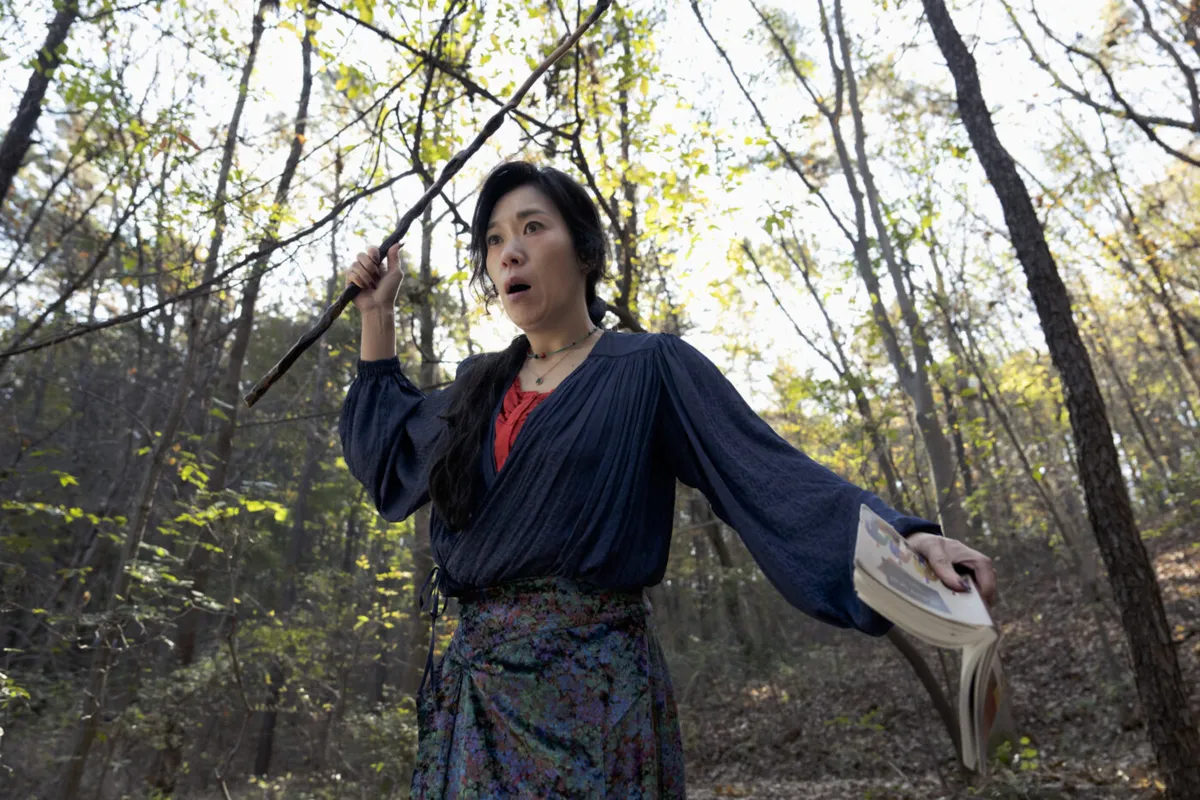
The film also highlights the invisible labour of women, with Man-su often receiving help from women, both overtly and covertly, despite his perception of being on a lone killing mission. For instance, after several days of spying on the alcoholic ex-Pulp Man of the Year Beom-mo and his unfaithful wife A-ra, Man-su finally attempts his first kill. However, clearly finding it hard to kill a man whose struggles mirror his own, Man-su takes too long and is caught mid-assassination attempt by A-ra. A struggle ensues, resulting in A-ra gaining control of the gun and eventually shooting her husband dead in an exasperated rage. Essentially, she finishes Man-su’s job for him. Much later, after Mi-ri’s son, Si-one, witnesses Man-su attempting to dismember his second victim and begins to have nightmares, a suspicious Mi-ri discovers the body buried under a new tree in the garden. To alleviate her son’s nightmares and cover for Man-su, she tells Si-one that what he saw was his father cutting up a pig to fertilise the tree with. All this is done while an unsuspecting Man-su believes his family knows nothing of his transgressions. Mi-ri’s cover story serves multiple purposes: protecting her son’s mental health and relationship with Man-su, shielding her husband from the consequences of his violence, and ultimately maintaining the family’s stability that Man-su is jeopardising despite his efforts to protect it. Meanwhile, A-ra demonstrates that the “invisible” labour of women can often include more decisive, overt intervention required to solve the crises others create. Ultimately, this mirrors real-world patterns, where women absorb the emotional and practical fallout of male actions, cleaning up messes, managing trauma, and preserving domestic order, while men retain the illusion of autonomy and receive credit for the outcomes they did not actually secure alone.
Killing the Competition
This combination of capitalism and patriarchy also leads to male violence, experienced and perpetuated by Man-su both inside and outside of the family. For example, the social pressure to be the masculine provider has a significant effect on himself, his father, and his son, revealing a cycle of intergenerational trauma and violence. After committing to murdering his most-significant professional competitors, Man-su’s decision to use his father’s old service gun from the Vietnam War may seem purely practical, given his immediate access to it. However, it also links his current actions to the expectations and violence placed onto his father’s generation. Historically, men have been expected to subject themselves and others to violence to fulfill their roles as providers and protectors. This is particularly relevant in the South Korean context, where, since 1957, all men aged 18 to 35 are expected to take part in mandatory military service, unless found exempt. The gun sheds light on these inter-generational expectations: Man-su’s father uses the gun to fight in a controversial war that was argued to have helped secure economic security for his country (as South Korea was fighting to strengthen its relationship with the USA and secure crucial economic aid for development). Man-su uses the gun in a way he himself argues will help secure the economic security of his family, even telling Mi-ri that he is “fighting a war for this family”. In both instances, violence by men is framed as the only solution. And, although not a violent act, we also see such pressures being passed on to Si-one, who gets caught stealing phones with a friend. As the older, male child, he is likely beginning to feel the pressure to take on his expected masculine role and provide for his family, whatever the cost.
Despite being socially and culturally mandated, taking on this role does, in fact, have a cost for these men. For example, we learn that the family home Man-su is trying hard not to lose was once his childhood home, and the barn he replaced with a greenhouse was the site of his father’s suicide. While the role of PTSD from war remains unclear in this tragedy, we do know that the catalyst was financial pressure resulting from his pig farm being wiped out by disease, a similar predicament to Man-su’s own. His choice to end his own life in turn traumatizes Man-su, who finds his body, and likely cements the belief that his worth is tied up in his ability to provide financially. Now in the same position, Man-su directs his violence outwards, yet still traumatizes his own son (even doing so in the same room of the house as his own father) through Si-one’s accidental witnessing of the attempted body dismemberment. Ultimately, this demonstrates that no matter the target or justification for violence, it inevitably harms all involved. perpetrator, victim, and witness alike.
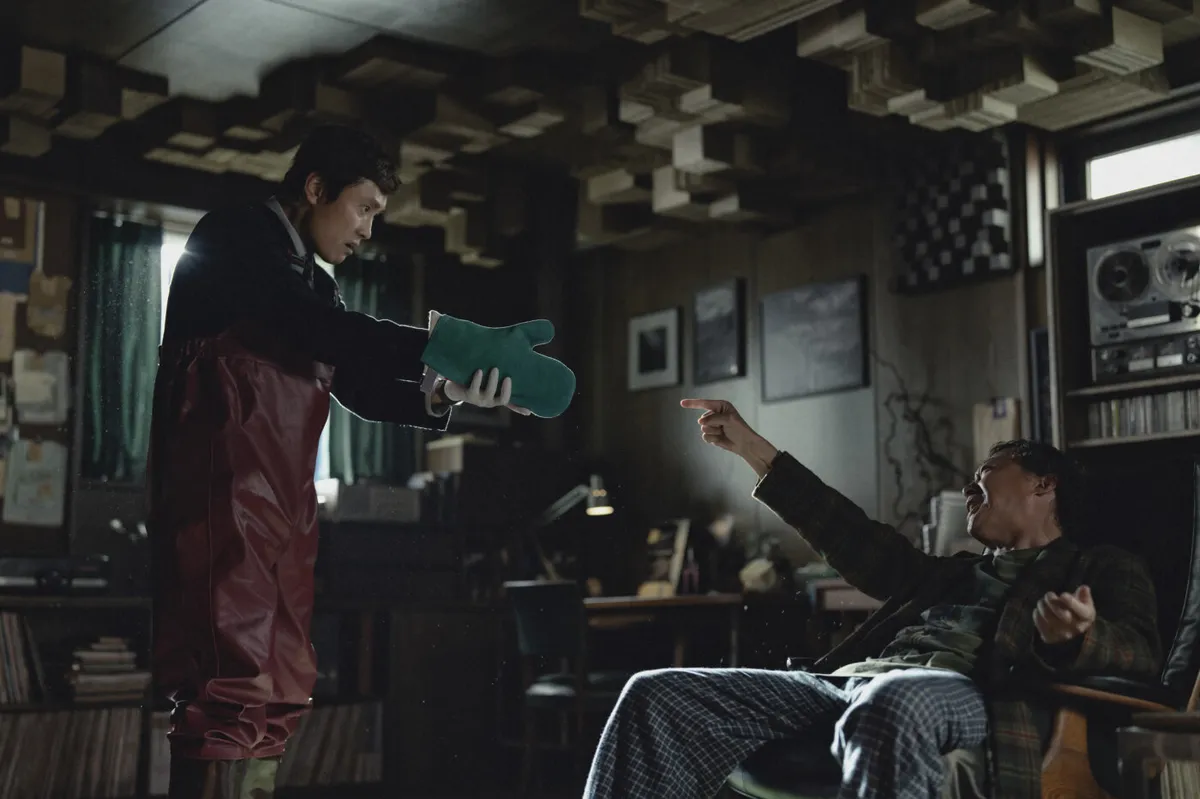
The lengths that Man-su goes to in order to maintain his family’s economic stability and the illusion of his success show the sacrifices required in order to succeed in late-stage capitalism. Each one of his victims represents a part of himself that he must sacrifice in order to achieve this success. Being the first, Beom-mo is the hardest for Man-su to kill, not just from inexperience, but because he is Man-su’s closest mirror. Beom-mo represents all of Man-su’s biggest fears: he is an alcoholic while Man-su is sober; his wife is cheating on him, and Man-su becomes paranoid Mi-ri is having an affair with her boss; he is a previously successful Pulp Man of the Year award winner who stubbornly refuses to look anywhere else but the paper industry for a job, a direct mirror of Man-su. However, Beom-mo also represents an unwillingness to ‘move with the times’, something capitalism demands, as we see him cling to analog methods. By killing him, Man-su not only kills off the part of himself that wants to stay stagnant and wallow in past achievements, but also the part with individuality and conviction. Under capitalism, it doesn’t matter if you prefer vinyl to digital or paper to screens; if you are unwilling to adapt, you will certainly be left behind.
Man-su’s next victim is Si-jo, who has begun working at a shoe store after losing his job. At first, seemingly content with his role and able to give his daughter some pocket money, after being pressed by Man-su we learn Si-jo also misses his old role in the paper industry. Man-su later murders him in a slightly swifter but still hesitant assassination. Here, Si-jo represents another fear for Man-su: acceptance of stagnation. Although he wishes to be in the industry he loves, Si-jo has sacrificed his professional pride in order to ensure his family can get by. But unlike Man-su, who could not endure retail, Si-jo tries to make the best of his situation and seems to thrive in his role (although receiving commission likely helps here). However, contentment means you are not moving forward, seeking new opportunities, success and growth, which capitalism demands. Thus, Man-su kills off the part of himself that would settle for survival over ambition.
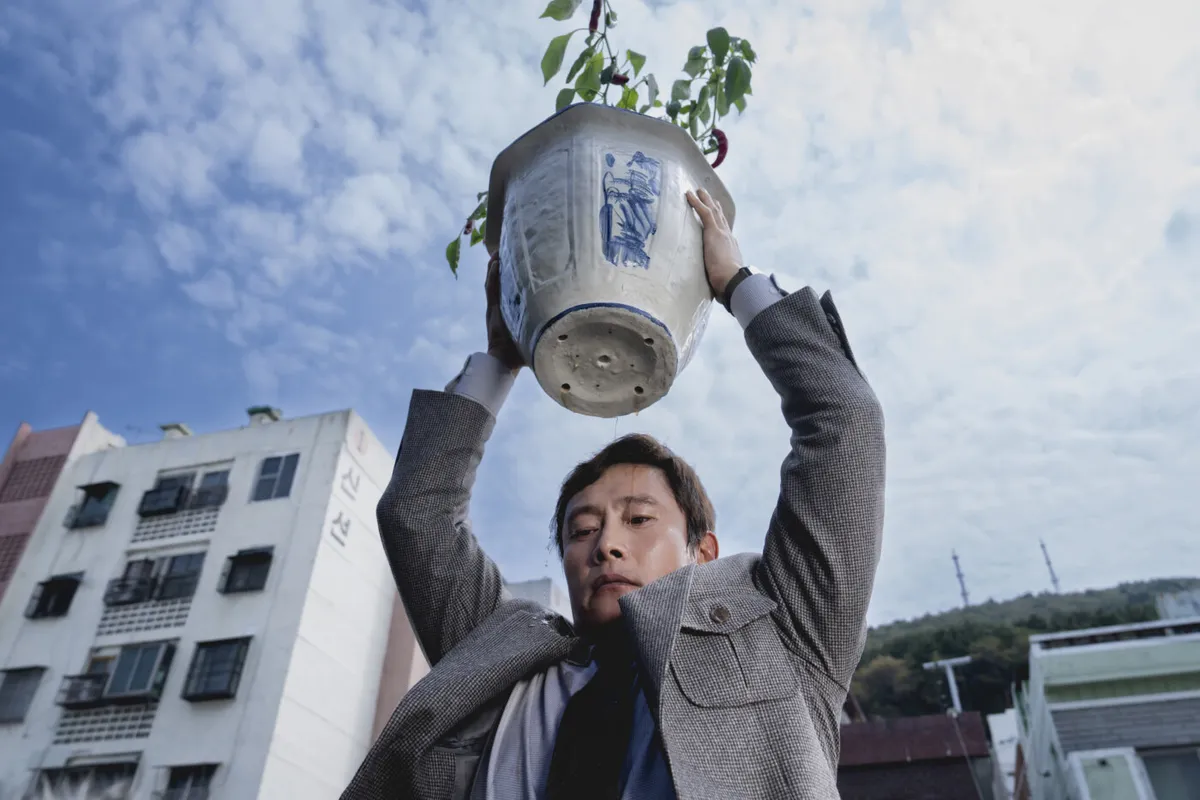
Finally, his last victim, Seon-chul, is a manager at Papyrus Paper. His murder is key to Man-su’s success, creating a vacancy that he can go for practically unchallenged. This final act dismantles the capitalist myth of meritocracy. In a true meritocratic system, the most skilled or deserving candidate rises to the top. Man-su’s killing spree proves that success under capitalism is actually about the ruthless removal of all obstacles. He must step over not only those below him, not only those on the same level as him, but also actively destroy those above him in order to seize their positions and, ultimately, achieve success. With every victim, it is clear that Man-su strips away another piece of his morality and shows that he is willing to do whatever it takes to succeed and thrive in the modern capitalist context, often requiring the sacrifice of self and others.
An Automated Future
Man-su’s total moral collapse is complete in the last scene of the film. After killing his competition, he secures Seon-chul’s old role at Papyrus Paper. In stark contrast to the first factory scenes at the start of the film, where Man-su is happily walking around a packed workplace and preparing to stand against the job losses of his subordinates, we now see him gleefully walking around a completely automated paper mill, no other workers in sight, having murdered several men to get there. This scene perfectly captures Man-su’s journey and the increasing demands late-stage capitalism puts on us. With an ever-decreasing number of roles due to downsizing and AI automation, the demand per role increases and the pressure on remaining positions intensifies, fueling fiercer competition among peers. Consequently, the ‘successful’ individual becomes increasingly isolated, working alongside machines rather than humans. This isolation pushes them further from the empathy and solidarity needed to recognize the system’s consequences and thus take part in the collective action needed for change. Overall, then, No Other Choice provides a sometimes bleak, always satisfying window into the increasing demands, social-pressures and isolation we face in the current stage of capitalism we find ourselves in.